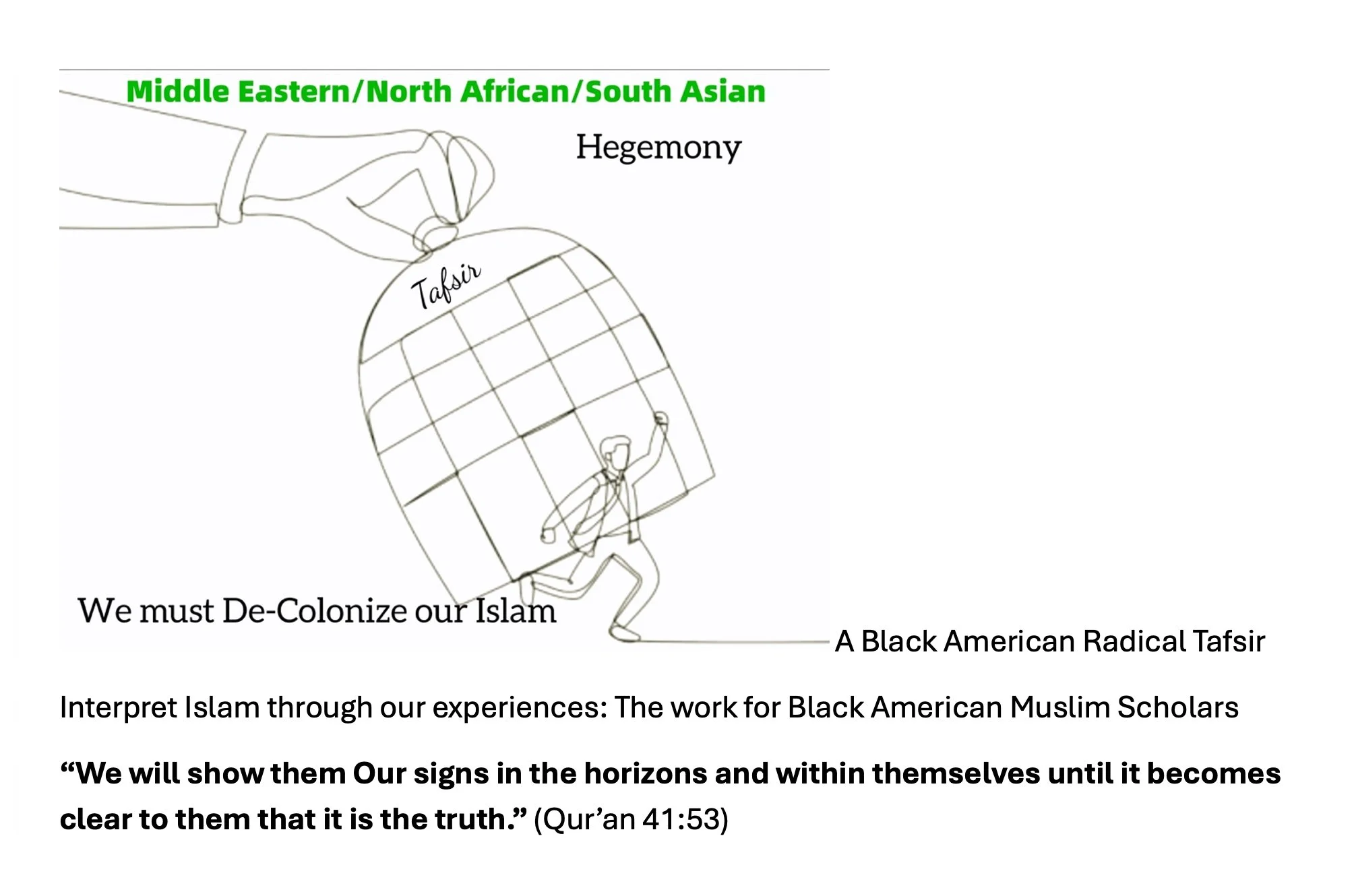
1. The Visual Metaphor: Hegemony and Containment
The central illustration is a metaphor for intellectual and spiritual control.
The Hand from Above: The arm reaching down represents Hegemony. In this context, hegemony refers to the dominance of specific cultural or national interpretations of Islam, specifically those from the Middle East, North Africa, and South Asia (as labeled in green). This hand controls the "narrative" or the "container" of the religion.
The Grid/Cage ("Tafsir"): This suggests that the dominant interpretations of the Quran have become a prison or a restrictive structure. It implies that the "official" understanding of Islam is often used to confine and dictate how the religion must be practiced, leaving no room for cultural specificity.
The Trapped Figure: This figure represents the Black American Muslim, confined by interpretations of Islam that do not account for their unique historical and social reality.
2. The Textual Argument: De-Colonization
"We must De-Colonize our Islam": This is the rallying cry. It argues that Islam, as practiced by Black Americans, has been colonized by cultural baggage from the "Muslim world" that is often racist, classist, or simply irrelevant to the Black American experience.
"A Black American Radical Tafsir": The word "Radical" here derives from the Latin radix (root). It calls for a return to the roots of the faith, but interpreted through a new lens, one that is inherently political and social.
"Interpret Islam through our experiences": This line asserts that Black American Muslims should not have to conform to Arab or South Asian cultural norms to be "good Muslims." Instead, their specific struggle against systemic racism in the West should be the primary lens through which they read the Quran.
3. The Theological Justification
The image concludes with a quote from the Quran (41:53):
"We will show them Our signs in the horizons and within themselves until it becomes clear to them that it is the truth."
By including this verse, the authors are grounding their argument in scripture. The claim is that Allah reveals truth not just through ancient texts or foreign scholars, but through the "horizons" (the external world and it’s history) and "within themselves" (the internal experience of Black Americans). It suggests that the Black American experience itself is a valid source of divine revelation and theological understanding.
This image is a call to action for Black American Muslim Scholars. It argues that true liberation requires breaking out of the "cage" of foreign interpretations (Hegemony) and developing a theology (Tafsir) that speaks directly to the Black American condition. It is a rejection of passive assimilation in favor of an autonomous, empowered, and distinctly Black American Islamic identity.